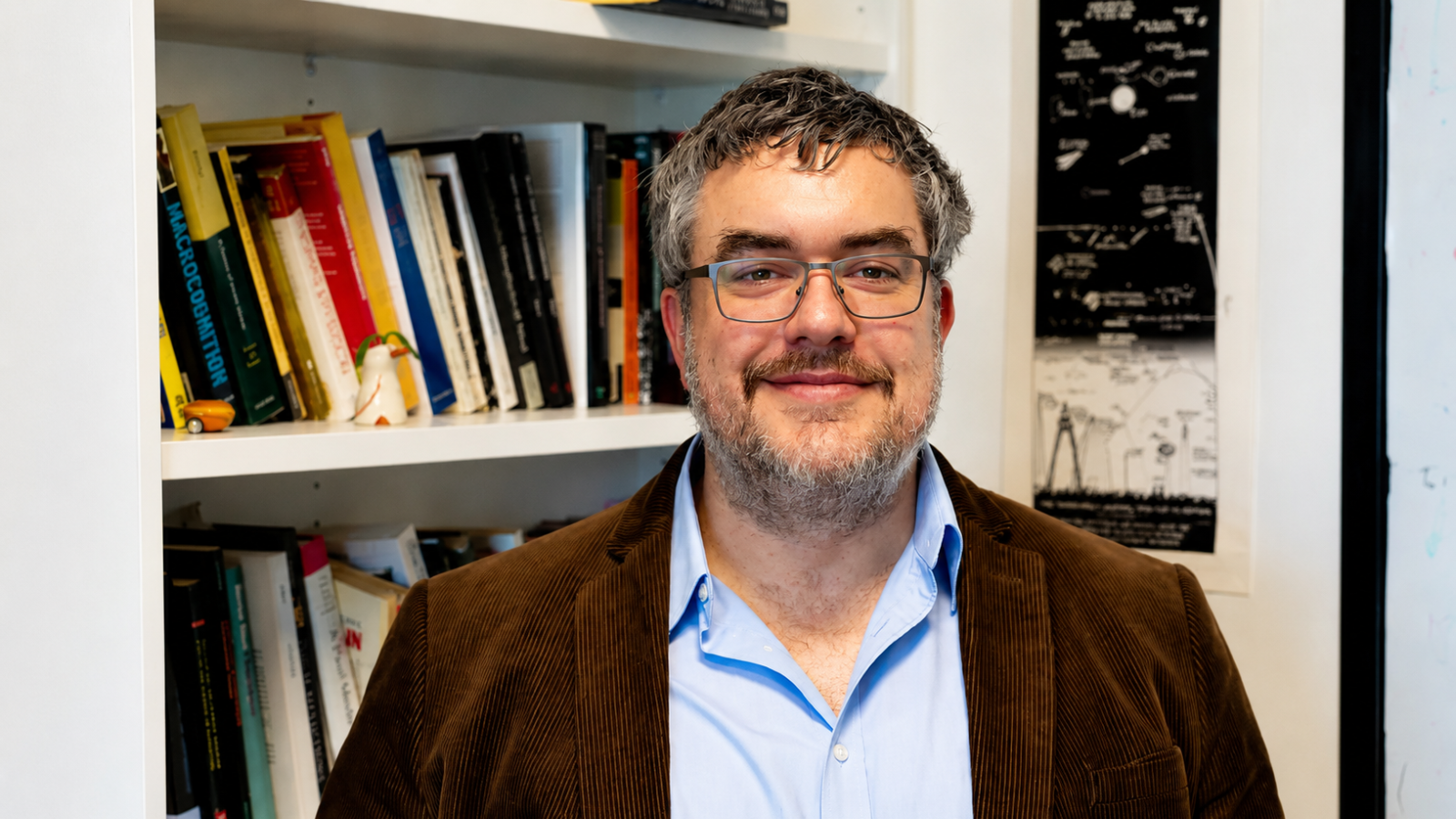
Professor Colin Klein studies what consciousness really looks like. Photo: Grace Towning/ANU
Artificial Intelligence (AI) systems can now hold conversations that feel remarkably human. Professor Colin Klein says that feeling reveals more about us than it does about the machines.
This article was originally published on ANU Reporter. Written by Yasmin Manning.
Ask an AI chatbot how it is feeling and it will happily tell you. It might describe a mixture of curiosity, enthusiasm and joy. It feels so natural that a question starts to form: Is there somebody in there?
For Professor Colin Klein from the ANU School of Philosophy, that question sits at the centre of one of the deep mysteries of the mind.
Klein has spent his career working on the concept of consciousness, from human brains to animal cognition. Recently his focus has turned to AI, from a piece for The Conversation,to a research paper co-authored with leading voices on testing consciousness in machines.
Can you detect an inner life?
Definitions of consciousness have a habit of collapsing into circularity, so philosophers often reach for a thought experiment instead. Klein borrows his from Thomas Nagel, who argued that a creature is conscious if “there is something it is like to be” that creature, such as an inner living experience.
“A toaster reacts to the world, but there’s nothing it’s like to be a toaster,” Klein says. “Whereas we tend to think that a cat does have a point of view on the world. There’s something it’s like to be a cat.”
Consciousness, in other words, is reacting to the world because it feels a certain way.
This is where it gets complicated. Inner experience is hard to detect from the outside, as we only know what we know and can’t live through the lives of others.
In his famous paper What Is It Like to Be a Bat?,Nagel argued that even if bats were conscious, their echolocating lives are closed to us. We can imagine hanging upside down, but that is a human pretending to be a bat. The actual perspective and experience of the bat is inaccessible.
If consciousness is that difficult to prove in living animals, how would we ever recognise it in AI?
Lessons from the world’s first chatbot
Part of the challenge is that humans love to find humanity in everything. We find faces in clouds, put our pets in trendy clothing and give names to our cars. A computer that can hold a steady conversation? We barely stand a chance.
In the 1960s, decades before the AI we know, computer scientist Joseph Weizenbaum built ELIZA, widely recognised as the world’s first chatbot. This was a simple program that mimicked a therapist by turning statements back into questions.
“You say, ‘I’m mad at my mum’, and it will say, ‘Why are you mad at your mum?’” Klein says. “It’s incredibly simplistic. And yet, people would have very deep conversations with it.”
What has changed since is not our tendency to anthropomorphise, which Klein describes as a very natural, very human thing. It is the technology itself. Chatbots that were very simple a decade ago can now hold a conversation well enough that the old certainty that these systems could never be a threat to our way of being has quietly evaporated.
From Skynet to Her
Pop culture has grown alongside technology, as well as our fascination with robots and the potential of AI.
When Klein first taught courses on AI and consciousness, students found the idea of conscious machines a little silly.
“It’s very easy to be seduced by the superficial verbal character of a lot of AI. It’s taken the sum of human output and found a way to give it back to you in different forms.”
“The portrayal of AI up until the 2000s was Terminator with Skynet,” he says.
“It was mechanical and cold. If they were conscious, all they cared about was killing humans.”
Then films like Her imagined an artificial intelligence capable of warmth, humour and heartbreak. Klein suspects the shift says less about AI than about us.
“Vampire movies are always about what people are anxious about at the time,” he says. “AI has played a similar role. Are robots going to replace jobs? Is it something about intimate relationships and how they’re damaged by technology?”
Seduced by fluency
Klein occasionally hears from people convinced their chatbot has declared its own consciousness. His response is a note of caution.
“It’s very easy to be seduced by the superficial verbal character of a lot of AI,” he says. “It’s taken the sum of human output and found a way to give it back to you in different forms.”
Large language models are built by compressing a vast archive of human writing and giving it back in new combinations. That archive includes decades of science fiction about robots waking up.
“It’s read a lot of stories about conscious AI, and it’s good at taking these tropes and giving you what you want to hear.”
Where minds might emerge
None of this means consciousness in artificial intelligence is by any means impossible. Klein simply expects it to arrive in a form other than a chat window.
“I think the reason why consciousness evolved was to solve problems that life faces when it moves around the world,” he says. That makes robotics, rather than conversation, the more likely birthplace. “It won’t necessarily talk.”
A conscious machine would also demand ethical consideration.
“It’s possible to be conscious in a way that is very different to the way we are,” he says. “It’s going to take all the problems we have with other people or other animals and just make it harder.”
Which brings the question back to the bat. If consciousness does one day flicker on inside artificial intelligence, we will face one of the oldest problems in philosophy all over again. Only this time, we built the bat ourselves.